
Become an AI Engineer(Step-by-Step Career Guide)
April 08, 2026
 Become an AI Engineer(Step-by-Step Career Guide)">
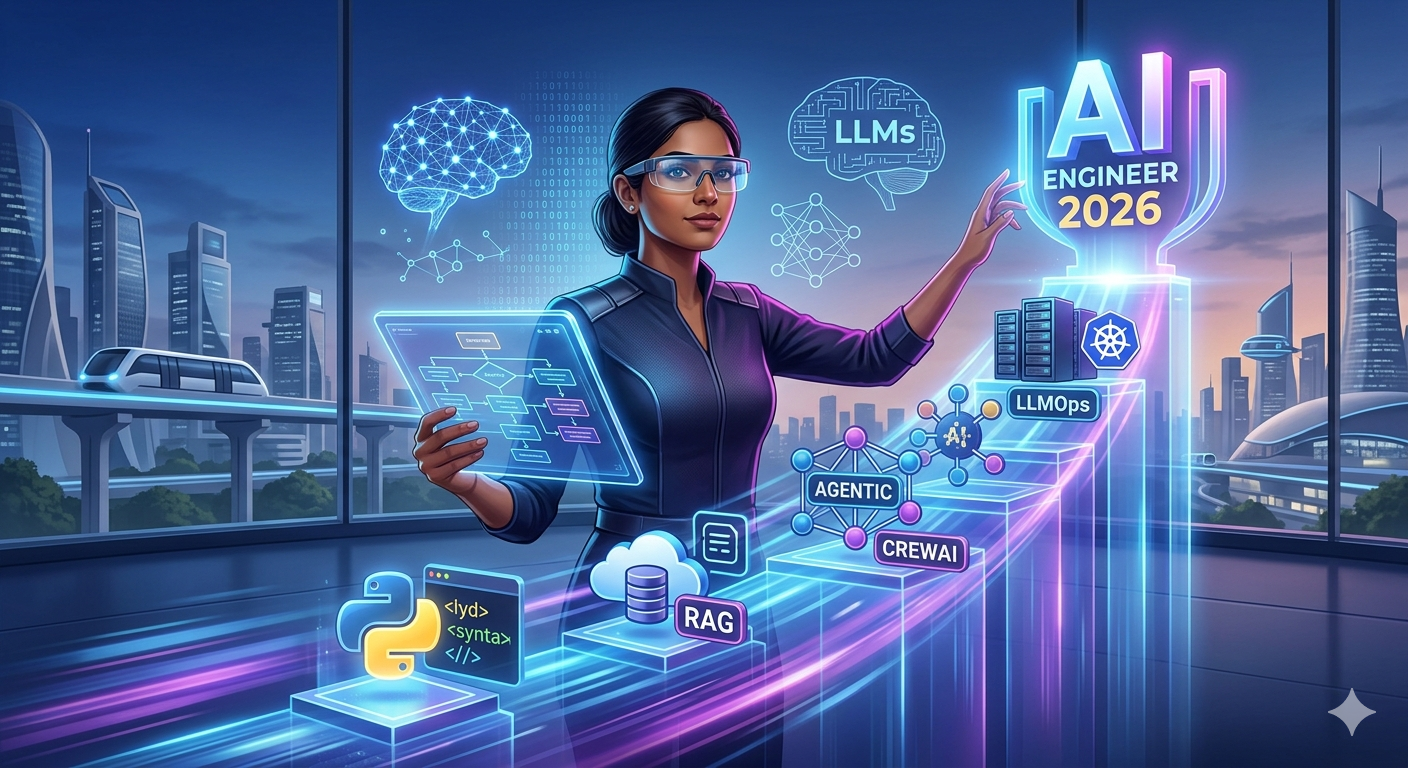
Becoming an AI Engineer in 2026 is no longer about just "learning to code"—it’s about mastering the art of building autonomous systems that think, reason, and execute.
If you’ve felt the shift in the tech landscape, you know the "software developer" title is evolving. This guide will show you how to ride the wave rather than get swept under it.
1. The Reality Check: Why AI Engineering is the Future
The era of the "Generalist Developer" is over. In 2026, companies are not just hiring coders—they are hiring engineers who can design intelligent systems.
AI Engineers now command up to 56% higher salaries compared to traditional software roles, making it one of the most lucrative tech careers today.
2. The Biggest Problem: Why Most Learners Fail
Most aspiring engineers are stuck in outdated learning paths. While the world is moving toward Agentic AI, RAG, and LLMOps, many are still learning basic Python tutorials.
- Irrelevance: Learning old ML concepts while companies demand real-world AI systems
- Overwhelm: Too many tools like LangChain, CrewAI, Pinecone
- Experience Gap: Companies want AI experience—but no clear path exists
3. The Solution: Become a Full-Stack AI Engineer
To succeed in 2026, you must evolve into a Full-Stack AI Engineer.
- Foundation Models: Build on top of LLMs instead of training from scratch
- Vector Databases: Manage AI memory and context
- AI Agents: Build systems that can take real-world actions
4. Step-by-Step Roadmap to Become an AI Engineer
Step 1: Learn Python for AI (Weeks 1–4)
Focus on asynchronous programming and APIs instead of basic syntax.
- Master OpenAI & Anthropic APIs
- Learn data handling with Pydantic
- Understand basic math (probability & matrices)
Step 2: Learn RAG (Weeks 5–10)
RAG (Retrieval-Augmented Generation) is the backbone of modern AI systems.
- Use vector databases like Pinecone or Weaviate
- Learn chunking and embedding strategies
Step 3: Build AI Agents (Weeks 11–16)
- Learn frameworks like LangGraph or CrewAI
- Build agents that can browse, calculate, and automate tasks
Step 4: Learn LLMOps & Deployment (Weeks 17–24)
- Deploy using Docker and cloud platforms
- Use evaluation tools to reduce hallucination
5. Salary & Career Opportunities in 2026
The demand for AI Engineers has grown by 163% year-over-year, making it one of the fastest-growing careers globally.
| Experience | India (LPA) | USA |
|---|---|---|
| Entry Level | ₹12L – ₹18L | $110k – $140k |
| Mid-Level | ₹25L – ₹45L | $160k – $220k |
| Senior | ₹60L – ₹1.2Cr+ | $250k – $450k+ |
Top Hiring Industries
- FinTech – Fraud detection & trading systems
- HealthTech – AI diagnostics
- Cybersecurity – Threat detection
6. Take the Next Step in Your AI Career
The opportunity to become an early AI expert is closing fast. By 2027, these skills will be the baseline.
Don’t stay stuck in tutorial hell.
Confused About Your AI Career Path?
Get a personalized roadmap based on your background, skills, and career goals. Don’t waste months figuring it out alone.
Book Free Career Counselling